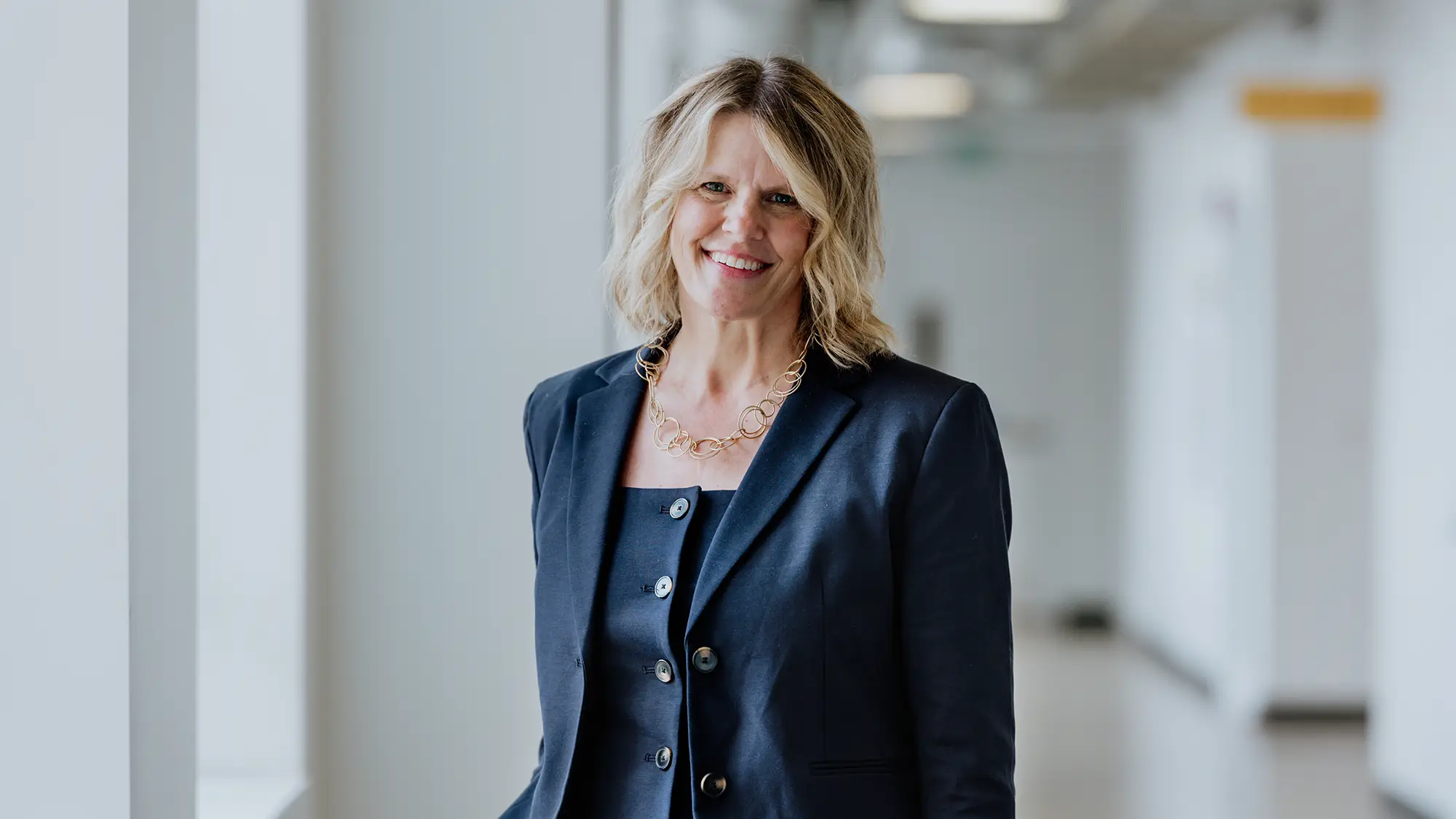
A native Pennsylvanian, Allison Puff took an uncommon path to becoming the Provost of College for Creative Studies in Detroit. From restaurateur to in-house graphic designer to professor, she has spent her life following her passions. Her deep commitment to human connection is both her superpower and her primary driver. Those connections, built through her lived experiences inside and outside of higher education, fuel an unwavering belief in artists and designers and their ability to problem-solve in ways no one else can.
SH: Thank you for your time today, Allison. Let’s start with what attracted you to College for Creative Studies.
AP: It came together at a really good time for me. It felt like a good combination of my skill sets from Farmingdale State College, which was much more business, engineering, technology and design, and Kansas City Art Institute, which was more fine art and craft. Those experiences worked well for CCS and I’m excited to get back into a more design-focused school. I was very connected to design Chairs and programs across the country and had a good impression of CCS from that. I had also met Don (CCS President) and Tim (former CCS Provost) previously at AICAD conferences, and they always seemed happy and positive about CCS. Don was one of those people who took the time to talk to everybody, and when I saw Rob (former CCS Interim Provost) last year, he said he left work every day happy. That’s not something you hear all that often anywhere. He spoke so highly of all the people at CCS and that impacted my decision.
SH: There is the textbook definition of a provost, but how do you see the role and the way it serves the college community?
AP: I see the role of provost as being a problem solver and connector. That’s what happens every day: a problem or multiple problems present themselves and we look for solutions that meet the community’s needs. That is one of the reasons I got into academic leadership. Even as a faculty member, I was always trying to figure things out, like making the promotion and tenure process easier. Plus, I get the opportunity to meet everybody across campus. I love faculty and learning about what they’re doing in their classrooms. I also know that institutions don’t exist without the staff that supports us in fulfilling the academic mission. If I can bring those two groups together to do some of that problem-solving and make everybody’s experience better, especially the students, that’s my happy place.
SH: What are you looking forward to the most in this new role?
AP: This is a really challenging time in higher education, and art and design education in particular. I’m really excited to work with this group of people on what the future can mean, and how we remain a really rigorous, exciting education while also meeting students where they are. And also thinking about what roles artists play in a future that includes AI. That’s the number one question, isn’t it? I would say, who better to tackle these questions than artists and designers? They are the people who have the ability to think about these challenges in such a different way than somebody with an engineering background, who might be led by different reasons. I just have such trust in the ability of artists and designers to solve problems in ways that no one else can. That makes me excited for the work here, and that makes me excited for our graduates also.
SH: As you begin meeting with faculty, staff, and students, what are the questions you’re most eager to ask, and what do you hope to learn?
AP: I want to understand the CCS student, what they want and need, and how we can provide that in a way that works while challenging them. I’ve always been a believer in having strong expectations for them (because I think they’re amazing), while supporting them in what they need to get there. I need to know more about them to be able to do that really well. Amy Ruopp and I are about to start having office hours every other week in the Taubman and Ford cafes during lunchtime to be accessible to not just students, but faculty and staff. I started doing that when I was at KCAI, and it was really helpful. There are some things that are so easy to solve just by having a conversation, and students don’t always know who to have the conversation with. Sometimes they come with really challenging personal concerns with peers or faculty members. I hope the faculty and staff will take advantage of it; they can also come and sit down and have a coffee and chat with Amy and me at one of these lunchtimes. It doesn’t have to be a problem; it can also be something really amazing that’s happening that I might not know about.
SH: What is something unexpected in your past that helped you prepare for this role?
AP: I used to own a restaurant with my husband. It was a very small bistro with about 25 seats that served New American cuisine with many different influences. He built the kitchen so he could do all the cooking himself. I was always there working at the restaurant while also chairing a department in a different state. I would walk in on Thursday night, work the front of house and do the books, and go back to Farmingdale on Monday for four days, where I was teaching online and in-person classes. I never liked conflict, and restaurants require you to deal with different people and their needs. It was very helpful in terms of my academic position.
SH: Can you tell us a little bit about your personal artistic practice?
AP: I have an MFA in Illustration, but I worked more as a graphic designer and taught more graphic design classes. I’ve worked as a freelance illustrator and graphic designer and worked as an in-house designer. People often ask me, in terms of having an MFA and working as a designer, it doesn’t seem like administration is very creative. I would push back against that really hard because it’s been some of the most interesting problem-solving I’ve ever done. It has such a huge impact on the community that we’re all existing in.
SH: What do you enjoy most about being a provost and what do you find is the most challenging?
AP: I enjoy that there’s still so much to learn. That’s another part of being in higher education that’s exciting to me. I constantly want to be learning about something new, and I don’t have the opportunity to ever not be learning something new in these kinds of positions.
SH: What do you want students to know about you?
AP: I want students to know that I am accessible. I’m kind of shy. The reason I share that is to let students know that whatever you find challenging doesn’t need to hold you back from the things that you want to do. Oftentimes, it’s helpful to share that with people and see that they’re on your side. They’re rooting for you to be able to do that presentation, or be successful at what it is that you’re trying to do, because everybody has something that they’re trying to overcome in order to do their job or succeed in the world.