
Mario Moore (’09 Illustration)
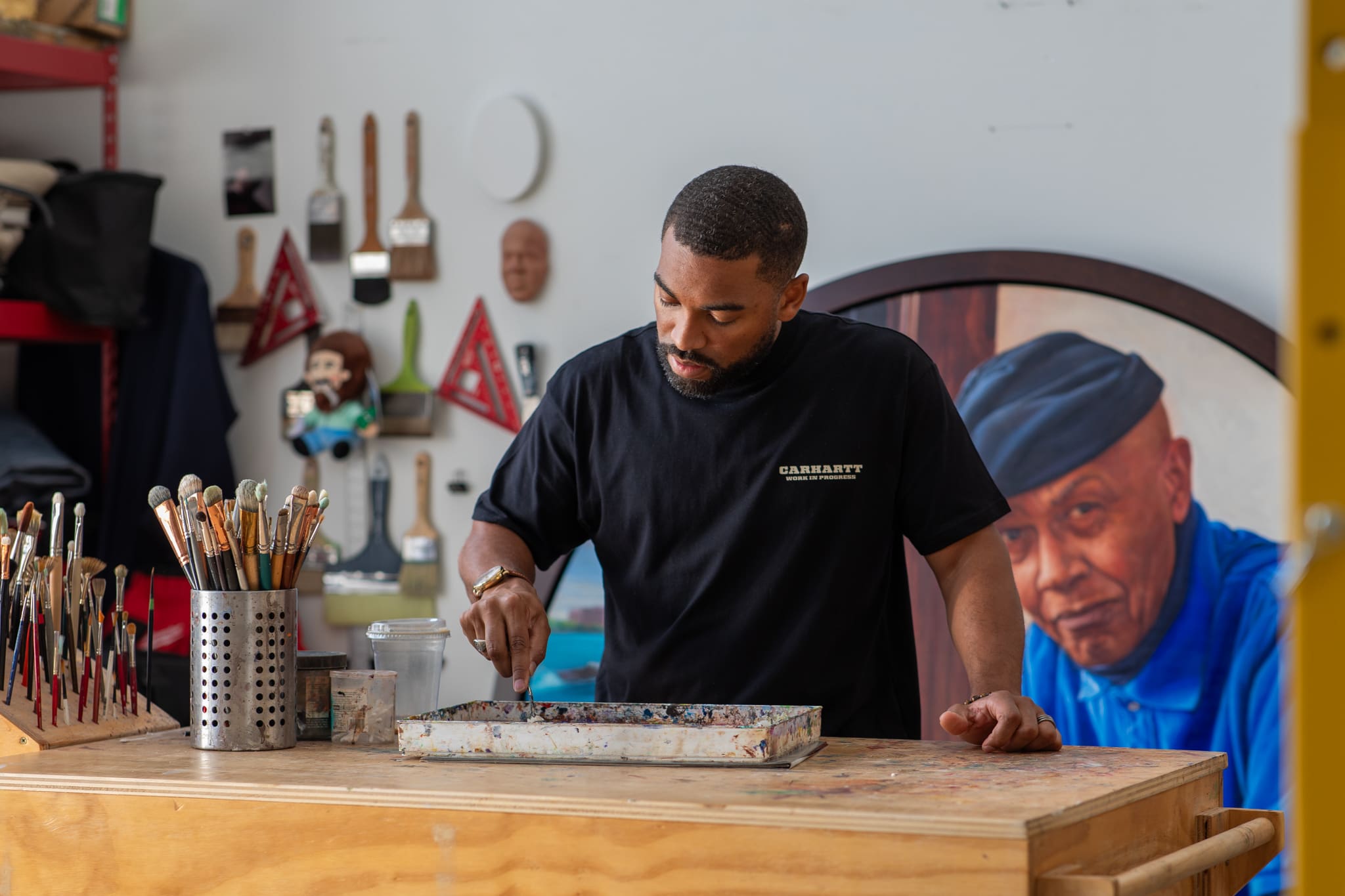
A Conversation with CCS Alum Mario Moore on Legacy, Family and the Art World
Recent spotlights at international events like Art Basel Paris have drawn attention to Detroit’s vibrant art community, but for local artist Mario Moore, ’09 Illustration, the spotlight has always found him. Moore’s work can be found in established galleries and even in the permanent collection of the Detroit Institute of Arts. While his CV is a laundry list of artistic achievements, it is his deep connection to heritage, the arts, the City of Detroit and, above all else, his family that keep him humble and authentic.
We spoke to Moore during a private tour of the DIA – a core location to his artistic journey – and at his studio space in Detroit. Crediting his lifelong passion for the arts to his mother, CCS Admissions Assistant Director and alumna, Sabrina Nelson,‘91 Fine Arts, and his upbringing in the Detroit arts scene, his story is one of the manifestation of a life surrounded by creative ideation, expression and freedom … and with some Kendrick Lamar or Motown blasting in the background.
The Interview
Hi, Mario. It’s nice to be here with you and talk to you in your studio. Can you introduce yourself in a few words?
My name is Mario Moore. I like to think of myself as just an artist. I think primarily people know me as a painter, but to me, the medium is only about the concept. So whatever medium I choose to use is the best way to kind of create the idea. So generally, I’m an artist.
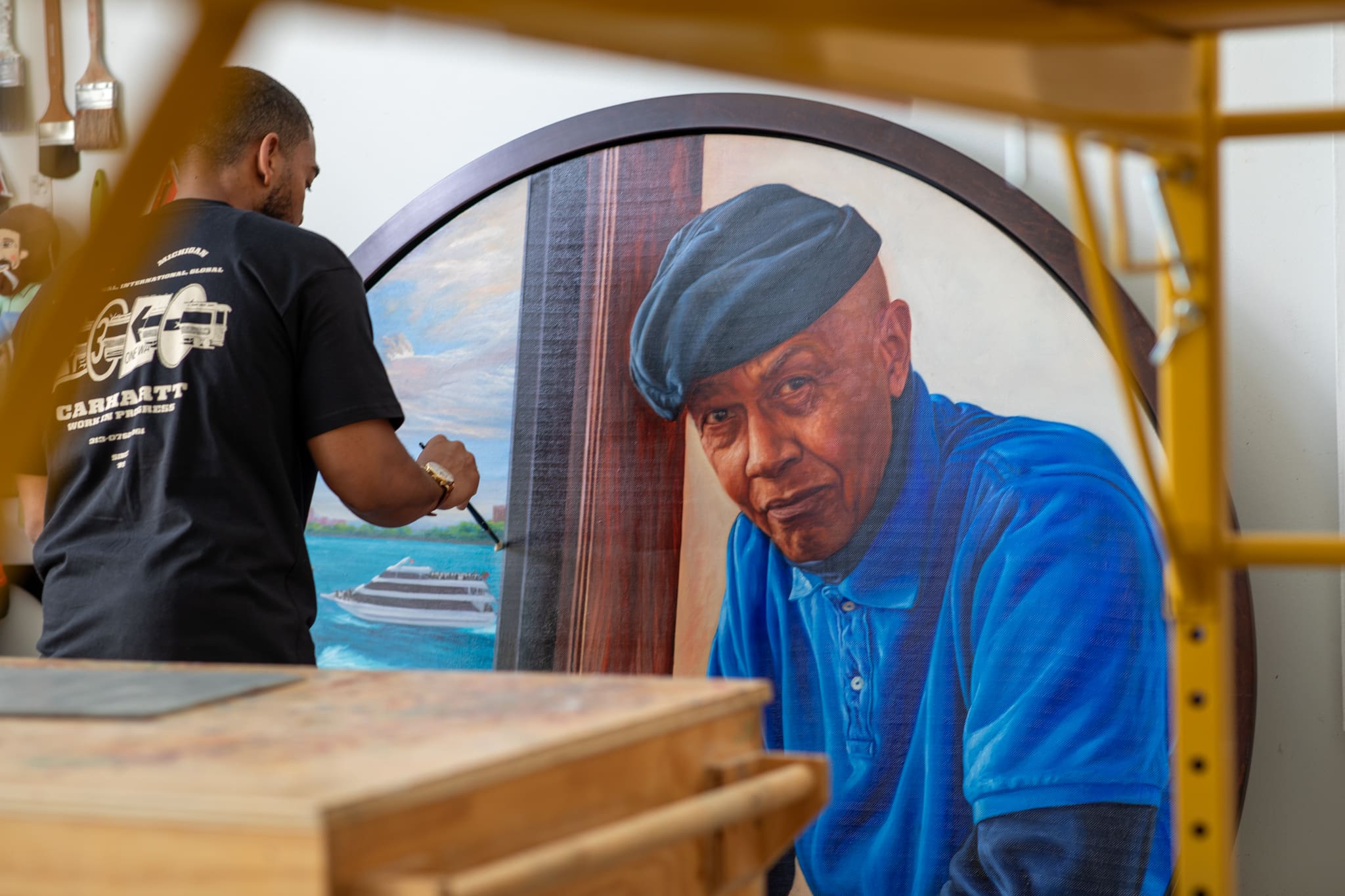
Mario Moore in his studio with his painting “Blues Man: Allie at Home.”
So speaking about the different types of mediums you work with, what are some of the bigger ideas behind your work?
I think broadly, what my work has to do with is telling human stories. And it’s done so in a way that invites anybody – and I do mean anybody – people within the art world and outside of the art world, to basically step into the work. I think the level of realism that I use is one, a kind of invitation to people who see the work, and also a way for people to respond, but also interact. So it’s the best way I can tell human stories that deal with American history, deal with everyday lives, deal with heart subjects. But stories about humanity.
When did you start your artistic career, and can you share with us some details that influenced your decision to become an artist?
I like to say that we are artists when we are kids. And from that perspective, I started to think about making work and being an artist since I was a child. But if we’re talking about, like, okay, you’re a professional now? I think the best way to think about having a career as an artist is to basically just begin and start. Like, having a degree in Illustration is amazing, but the concepts and ideas and the processes and putting together shows and exhibitions, you know, happened before college. And CCS just helped me along with that. But yeah, as a professional, my career started around 2012, 2013.
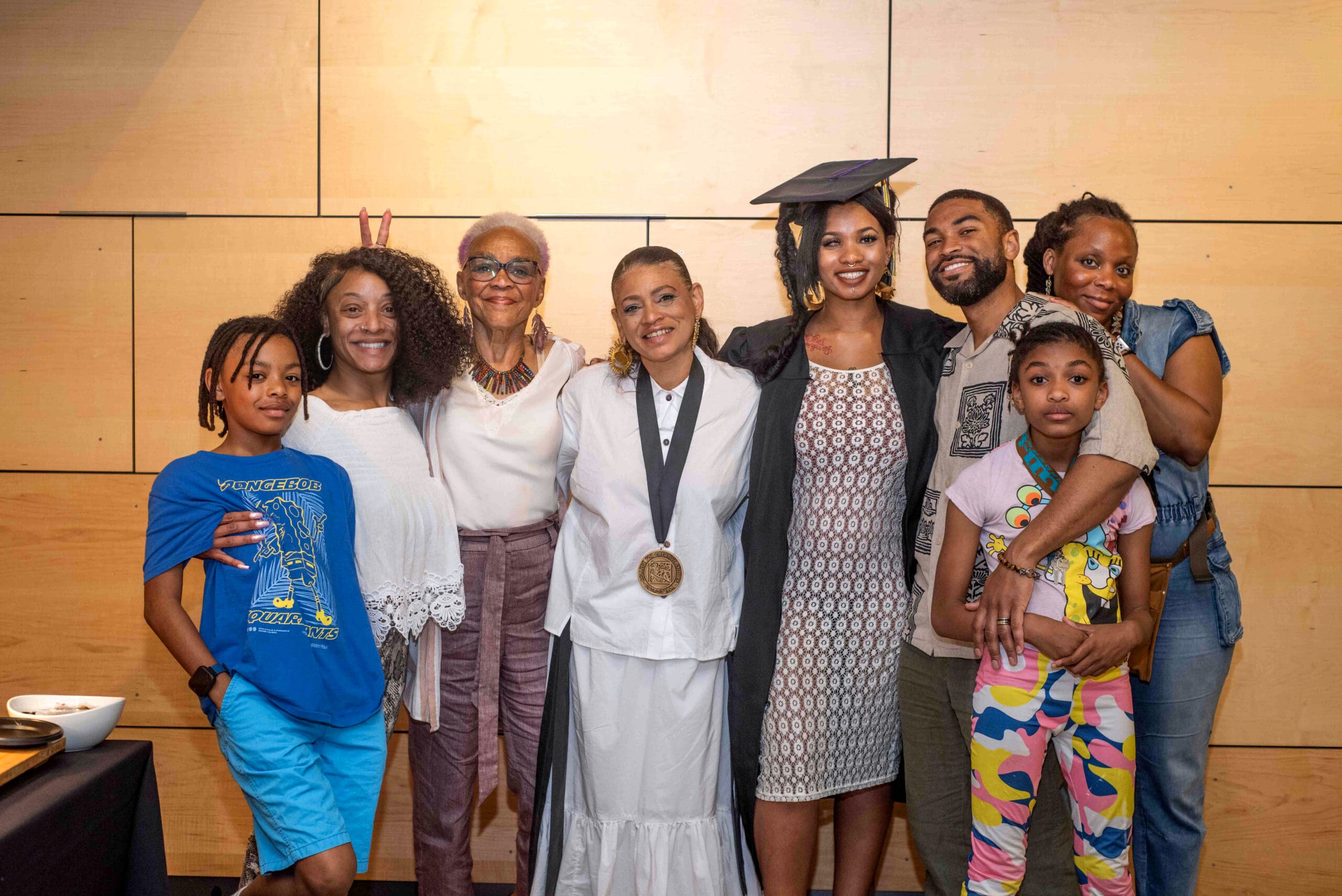
Mario Moore with his mother, Sabrina Nelson, ’91 Fine Arts, sister, Sudani Shaah, ’25 Studio Art and Craft, and family.
So before that time, though, was there someone or something that inspired you to follow this artistic path?
My mom, Sabrina Nelson, is an artist, and I just grew up in art, grew up in Detroit, going to all the art exhibitions, grew up with our artist friends, being in their studios, seeing them, basically turning an empty canvas into, you know, something that was incredible. I think that the magic was in that these friends of hers and she herself had these ideas and they just birthed them. And they came out of nowhere. I love the concept that you can create something and start something new. So, yeah, my mom has been a big inspiration to me in becoming an artist.
And with watching her career, her artistic path and her friends and their careers in the arts, and now you being an artist yourself, I’m sure you have noticed that there’s a lot of trials and tribulations along the way. What kind of challenges have you faced as an emerging visual artist when you think back to that time?
Yeah, I think life, you know, in general, is going to have its valleys, it’s going to have its hills. It’s not just going to be an upward motion, but I think the best thing to do is to continue being confident in yourself, and also believing that you were meant to be an artist. But also being an artist is work. It’s not an easy thing, right? I think there’s something really dedicated and difficult about whether you have the money or not, or whether you have a regular job, maybe you’re working in a deli shop, whatever it is, but after that job, then you focus on your career, you focus on your art. For me, when it comes to, like, some of the difficulties, I think it was, you know, considering the different pathways I wanted to take, when it came to Illustration, I really was thinking about, oh, man, how am I going to make money? And, you know, I thought about children’s books, I thought about sports illustration. I thought about all those things. And then over time, I realized I didn’t like working for anyone. I didn’t like to create somebody else’s vision. And that ultimately led me to, like, oh, you really want to make your own work. So just following that pathway 100%, even if it wasn’t really fruitful at the beginning, you know.
“It’s trusting that you have something to say, trusting that you have the dedication to continue to do it and continue to say it. And that’s what has led me to where I am now, just believing in myself, which I think can be hard for a lot of artists.”
–Mario Moore
I completely agree. But even through those challenges, you have achieved incredible success. So what is your definition of career success in the arts?
I believe that career success for me is basically having my bills paid. Not having to worry about finances, but the most important thing is that I’m able to create and make what I want to make without any limitations. Granted, I’m blessed, I love it, that it’s showing in museums, I love that it’s in galleries, I love that. But for me, it’s the ability to make the work and create the work, and to be able to sustain that. It’s not about being the biggest artist. It’s not about being the most famous artist. It’s about just the ability to create your ideas and your concepts without limitations. That, to me, is a definition of success. If I can go to the studio every day and make what I want to make, oh, what? That’s everything. That’s everything.
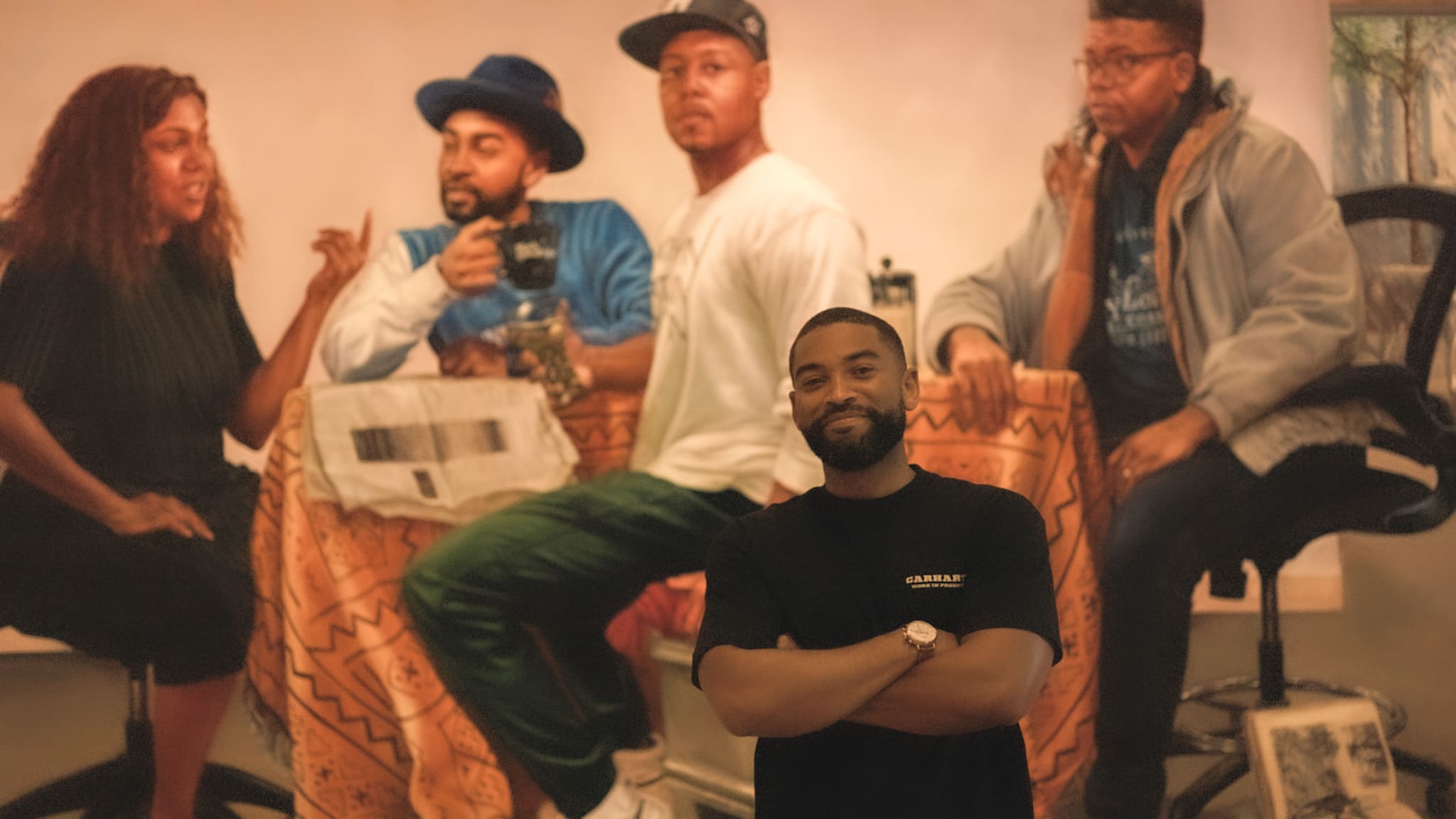
Mario Moore in front of his painting “The Council” located at the Detroit Institute of Arts.
Well, speaking of having your work in museums, we know that you have work in the Detroit Institute of Arts, and through other interviews and knowing a little about your history, it’s a very important place to you. Can you touch upon what it means to have your work shown there?
You know, I think it’s very special that I have work in the Detroit Institute of Arts. I have work in other museums around the U.S. and I love those institutions, but to be able to have work in the museum that you literally grew up in as a child, right? And you look and you see all the paintings on the walls and you imagine that one day it might be possible to have your work on those walls? Even though it seems, like, crazy to even think that way, but to imagine it and then to actually make it happen and see it is very, very fulfilling, but mind-blowing. To have it here, where I saw some of the first paintings I saw in my life, in a place where I used to draw in the galleries as a kid, a place where my dad met my mom when he was working as a security guard, and a place where my dad still works. So it’s awesome to see people going to look at my paintings in a way that I did when I was a kid looking at other people’s paintings, you know? It’s very special.
Continuing that thought about the DIA… I heard about an exciting collaboration. Can you tell me more about it?
Yeah, so as an artist, I am one of those people, if you go with me to any museum around the world, they usually have audio tours. When I listen to the audio tours, my hope is that it adds some information to something that I didn’t know, especially when I think about people who are new to art or it might be their first time in a new museum. So I am doing a project with the DIA where I am giving an audio tour of all the works that I love in the museum, and of my own work. So it will be the Mario Moore tour of the DIA, which, I think, is kind of dope. It’s incredible.
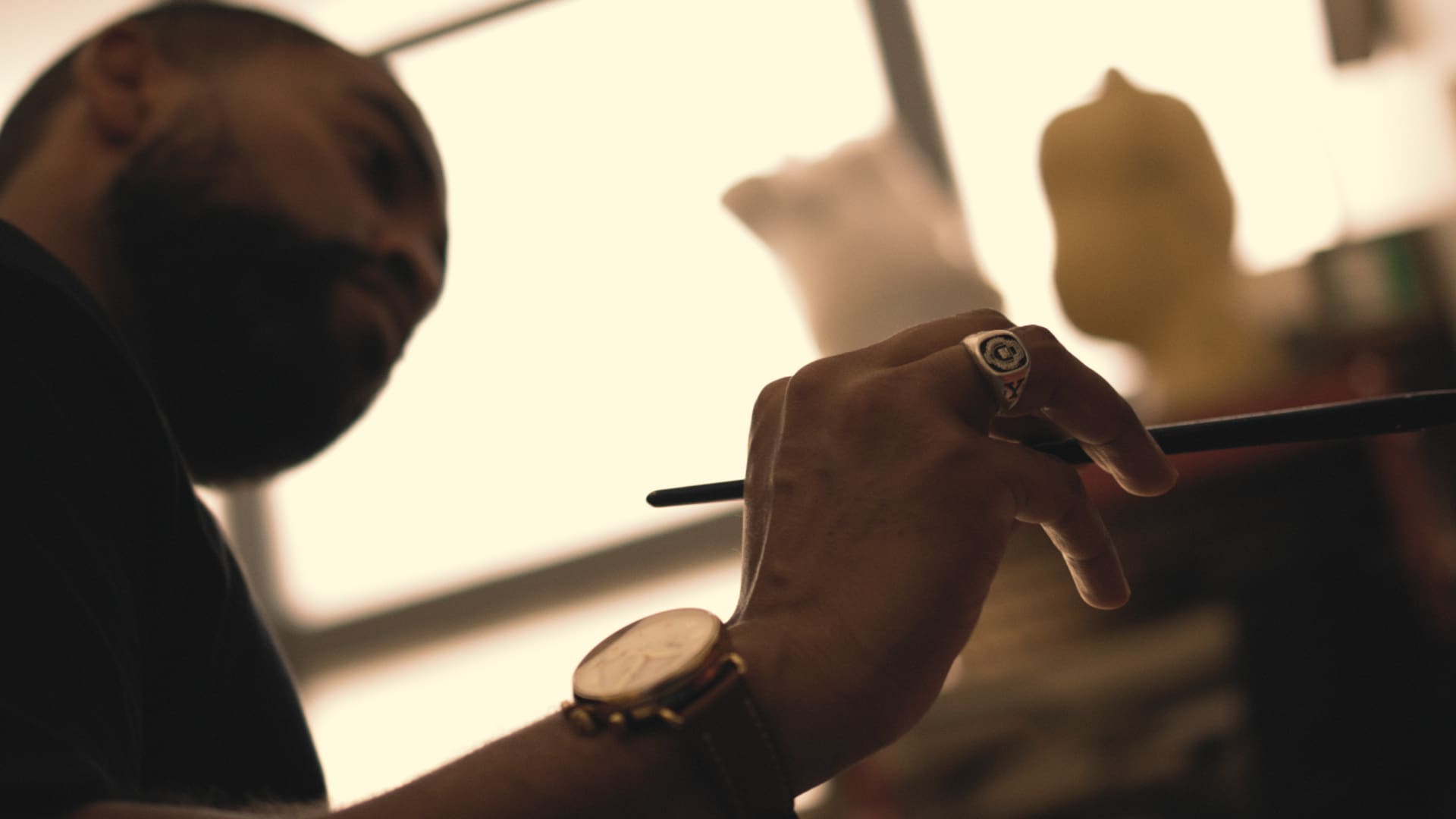
Mario Moore painting in his studio in Detroit, Michigan.
Could you speak about a few of your favorite gallery spaces or works of art at the DIA that you are drawn to or inspired by, that maybe some people will be able to hear about from your perspective on the tour?
Well, my favorite painting in the DIA is Artemisia Gentileschi’s painting, Judith and Her Maidservant with the Head of Holofernes. I love that painting because it’s the way she painted it, but it’s also the way in which she pushed forward the concepts and ideas of Caravaggio, and she did it better than he did. My favorite part about that piece is the head at the bottom of the canvas. Like, when you see it, it’s like got the texture, the brush strokes. There’s greens and grays, all painted in there. But it’s just the luminosity that you see from that painting. And then the other space that I really love is the Dutch galleries. I’m a Rembrandt fan. So Rembrandt to me is like the best person who does illumination of light. And when I think about my own work, it’s always something that I’m trying to kind of imbue into the work is like this idea of light. And Rembrandt is great at directing you into the places he wants you to look at. So these are also a part of the audio tour. And then there’s the one Velázquez painting in the collection. It’s amazing that Detroit has a Velázquez painting. And to me, when I talk about painters that influence me, painters that I look at, I feel like Diego Velázquez was one of the first modern painters in history. And also, I would call him probably the best painter ever.
So, thinking about if you mentored younger artists or CCS students who are beginning their art careers, what single most important piece of advice would you offer them?
I think the single most important advice that I would offer a young artist – a CCS artist – is to understand that there is not one pathway. There are many options for you, as far as a career in the arts. And I think a lot of times, for younger artists and also dealing with parents and family members who know nothing about art, they’re limited in their perception of what they can do with the talent that they have. So for me, it’s like, always remain open, especially when you get to CCS. Take as many classes as possible in every department. Develop all the skills that you need in other spaces, like take a glass class, take sculpture, take all of these things, because you never know how they will play in your practice. You never know what will happen after you graduate. And when you have so many skills developed, it’s a way to tap into another side of your brain. Like recently, a couple of years ago, I was taking a stone sculpting class and it was so interesting to me because usually when I’m in the studio, I need music, whether I’m doing a clay sculpture or whether I’m painting or I’m drawing. But when I was doing stone sculpture, it felt really meditative. I didn’t need any music. One, because you can’t hear it at all. But also, it just kind of created another kind of creative pathway in my mind. So when I went back to painting and I went back to drawing, it just kind of brought something new to me. I think that’s the best advice I can give is to just be open.
“I believe that career success for me is basically having my bills paid. Not having to worry about finances, but the most important thing is that I’m able to create and make what I want to make without any limitations..”
–Mario Moore
Speaking of that playlist, what’s your go-to? Who’s your go-to artist?
Kendrick Lamar lately has been my go-to artist in the studio, but I’m also like a super Detroit guy; Motown is heavy, it’s always playing in here. I love techno too. So I listen to DJ YG a lot. I listen to Dwele. Yeah, it’s a lot of different music, and it also depends on how I’m feeling. Because also as an artist, the one thing that I think a lot of people focus on is skill set, right? Which is incredibly important. Things that you need to learn, things that I think you should have. But the one thing I’m looking for in my work is a feeling. The feeling of whatever I’m making is more important than the way the thing was put together, right? So music really plays a part in that. That’s also the question you get all the time. How do you know when the work is done? I don’t know. You can work on any piece of artwork for the rest of your life if you want. For me, the most important thing is: does it have the feeling I want? When it has the feeling, I know it’s done.
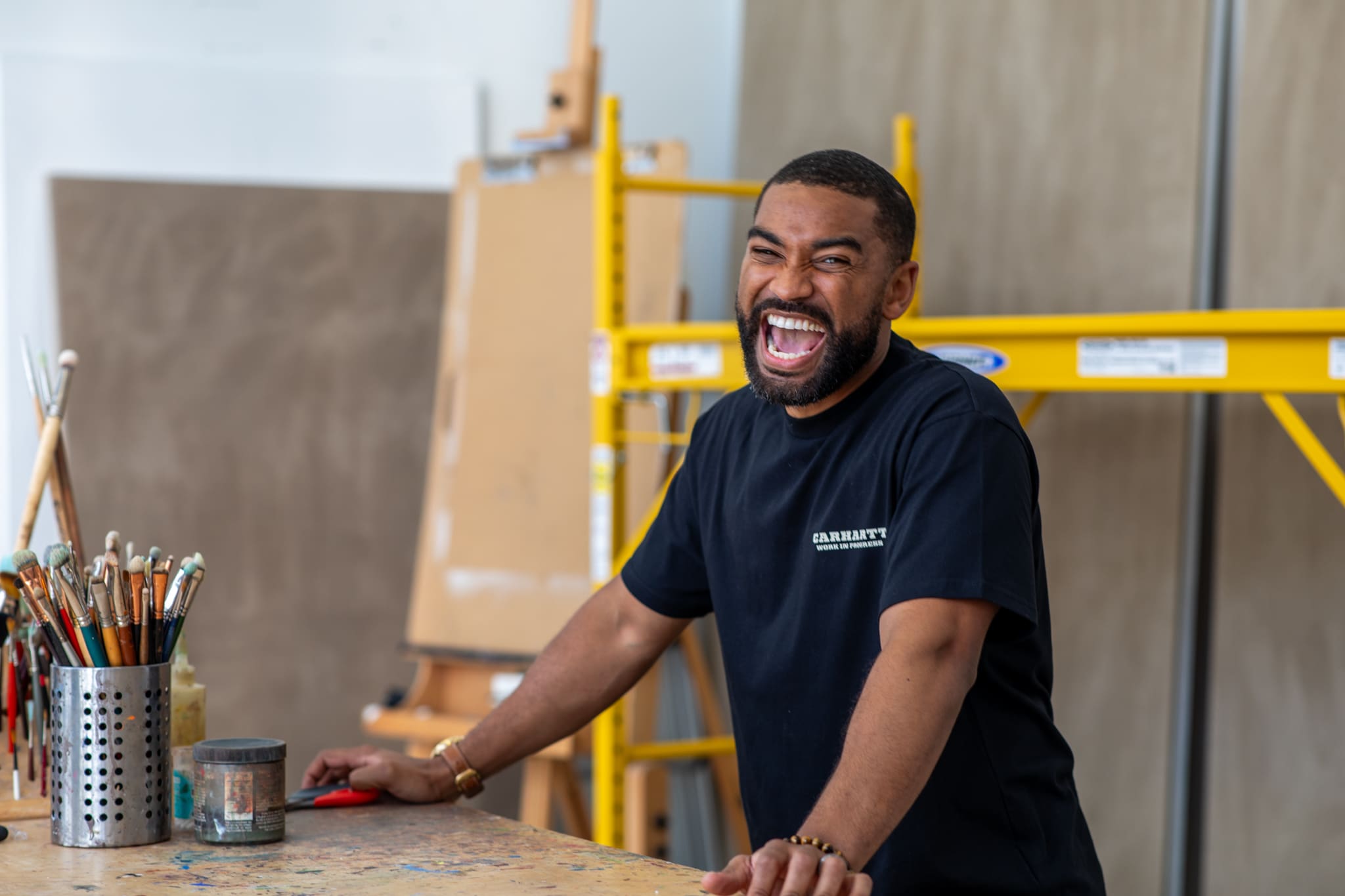
Mario Moore in his studio in Detroit, Michigan.
That’s so interesting. Okay, last question. What are you most looking forward to working on next?
I have a passion project. And I think every artist has passion projects. Things or ideas that are so big, you have no money for them. But you’re determined to make it happen. I am most excited about doing a large outdoor public sculpture of Malcolm X. That’s the thing that I’m most excited about right now. Again, no money involved, no funders, no nothing. But that’s what I’m working towards, to do a large outdoor public sculpture of Malcolm X for the city of Detroit, and in granite, I believe, when it’s done – because it will get done – it’ll be the first outdoor, full-figure, public sculpture of Malcolm X in the U.S. There is not one.